
Noise-induced hearing loss is one of the most common workplace injuries in Australia, and one of the few that is almost entirely preventable. It also happens slowly enough that most people do not notice until the damage is permanent.
This guide covers what noise actually does to hearing, what NSW law requires of employers, and how workers and businesses in Western Sydney can stay on the right side of both their obligations and their hearing.
How Workplace Noise Damages Hearing
Inside the inner ear, thousands of tiny hair cells convert sound into nerve signals. Loud noise physically damages them, and once they are gone they do not grow back. The loss is permanent and it is usually the higher pitches (the consonants that carry clarity in speech) that go first.
That is why noise-induced hearing loss so often shows up as “I can hear people, I just can’t understand them”, especially in a noisy crib room or pub.
The Early Warning Signs
- Ringing or buzzing in the ears at the end of a shift.
- Muffled hearing after work that clears by the next morning, a temporary threshold shift and a clear warning.
- Needing the TV louder than the rest of the household.
- Struggling to follow conversation in a noisy pub or family gathering.
- Missing the reversing beeper, the two-way, or someone calling out on site.
Ringing after a shift is not “just part of the job”. It is your ears telling you the exposure was too high.
How Loud Is Too Loud?
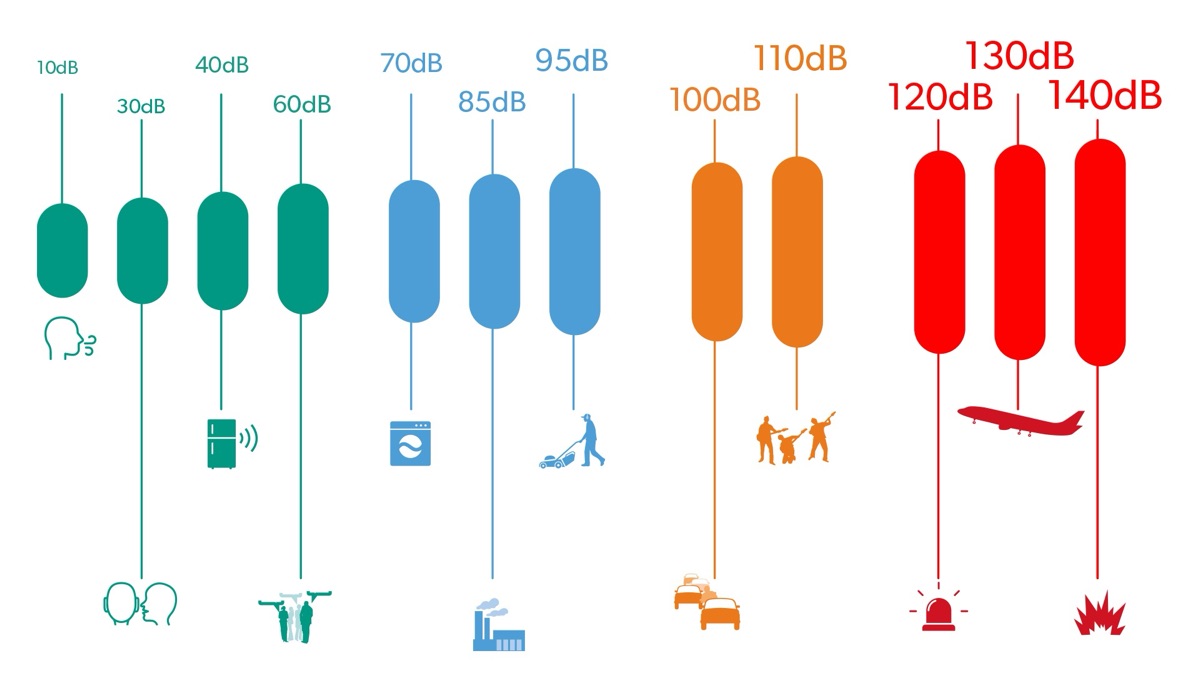
Under the NSW Work Health and Safety Regulation 2017, which mirrors the model WHS Regulations used around the country, the exposure standard for noise is:
- LAeq,8h of 85 dB(A): an average over an eight-hour working day, and
- LC,peak of 140 dB(C): a peak level that must never be exceeded.
Because the scale is logarithmic, every 3 dB increase halves the time you can safely be exposed. Eight hours at 85 dB(A) carries the same dose as four hours at 88 dB(A), or two hours at 91 dB(A).
Typical Source |
Approximate Level |
What It Means |
Normal conversation |
Around 60 dB |
Safe for any length of time |
Busy traffic, vacuum cleaner |
Around 70–80 dB |
Generally safe, but tiring |
Petrol mower, workshop machinery |
Around 90–95 dB |
Protection needed well before a full shift |
Angle grinder, chainsaw, nail gun |
Around 100–110 dB |
Damage possible within minutes |
Jackhammer, impact tools at close range |
Around 110–120 dB |
Hearing protection essential |
A practical rule of thumb: if you have to raise your voice to be understood by someone a metre away, the noise is likely at or above the level where control is needed.
Which Workers Are Most at Risk
- Construction, demolition and civil works.
- Manufacturing, engineering and metal fabrication.
- Mining, quarrying and heavy transport.
- Agriculture and landscaping: tractors, chainsaws, blowers.
- Motor mechanics, panel beating and tyre fitting.
- Emergency services and defence personnel.
- Musicians, sound engineers, and hospitality and nightclub staff.
- Airport ground crew and baggage handling.
What Employers Must Do
WHS law asks employers to work down the hierarchy of control rather than reaching straight for earplugs.
- Eliminate the noise where possible: a quieter process, or removing the task entirely.
- Substitute with quieter plant and tools. Noise output is a legitimate purchasing criterion.
- Isolate: enclosures, acoustic barriers, distance, and scheduling noisy work when fewer people are present.
- Engineering controls: damping, silencers, maintenance. Worn bearings and blunt blades are noisy.
- Administrative controls: job rotation, limiting exposure time, signage for hearing protection areas.
- Personal protective equipment: earplugs and earmuffs, as the last line, not the first.
Audiometric Testing Is a Legal Requirement, Not a Nice-to-Have
Where workers are frequently required to use hearing protection to keep them below the exposure standard, the WHS Regulation requires the employer to provide audiometric testing: within 3 months of the worker starting, and at least every 2 years after that.
This serves two purposes. It gives the worker early warning while the loss is still small, and it gives the business a documented baseline. Without a baseline, it is very difficult to show what hearing a worker arrived with.
Pre-Employment Hearing Screening
A pre-employment or baseline hearing assessment establishes a worker’s hearing on day one. For employers in noisy industries it is straightforward risk management:
- Documents pre-existing hearing loss before the worker is exposed to your workplace.
- Creates the baseline that future two-yearly tests are compared against.
- Identifies workers who need closer monitoring or extra protection.
- Supports fitness-for-duty decisions where hearing alarms and verbal instructions are safety-critical.
- Demonstrates a genuine WHS program if a claim is ever made.
New Sound Hearing provides hearing assessments for workers and is a registered provider with icare and the NSW workers insurance scheme. Our principal audiologist, Leena Kothari, has assessed Australian Defence personnel and workers with industrial hearing loss across more than 20 years of practice.
What Workers Can Do
- Wear protection every time. Removing earmuffs for even a short period in a loud area undoes a large share of the protection across the shift.
- Get the fit right. Foam plugs must be rolled down, inserted deep and allowed to expand. A badly inserted plug gives a fraction of its rated protection.
- Match the protection to the noise. Over-protection is a real problem. If you cannot hear alarms or workmates, that is a safety risk in itself.
- Consider custom earplugs. Moulded to your ears, they are more comfortable across a full shift, so they actually stay in. We make custom protection, including for musicians and sound crew.
- Give your ears quiet time. Avoid stacking loud hobbies on top of a loud shift.
- Get tested. Do not wait for your employer to organise it. A baseline test is worth having regardless.
Industrial Deafness Claims in NSW
If your hearing loss is related to work noise, you may be able to lodge a workers compensation claim in NSW. Claims generally require an audiological assessment documenting the loss and its pattern. Because noise-induced loss has a characteristic shape on an audiogram, a proper diagnostic test, not a quick screening, is what is needed.
Start by having your hearing assessed and talking to your employer or your union about the claim process. We can complete the audiological assessment as a registered icare provider.
Frequently Asked Questions
Can noise-induced hearing loss be reversed?
No. Once the hair cells in the inner ear are damaged, the loss is permanent. It can be managed well with hearing aids, but prevention is the only cure, which is why testing early matters.
How often should workers have their hearing tested?
Where workers frequently need hearing protection to stay under the exposure standard, the WHS Regulation requires testing within 3 months of starting and at least every 2 years thereafter. Many businesses test annually in high-noise roles.
Do earmuffs or earplugs protect better?
Both work when fitted correctly. Earmuffs are easier to use consistently and easier to supervise; earplugs are better under helmets and in heat. For very high noise, both can be worn together.
My ears ring after work but my hearing seems fine. Should I worry?
Yes, it is worth acting on. Ringing after noise exposure is a sign the exposure was too high, and repeated episodes often precede permanent loss. Read more about tinnitus testing and management.
Can my employer make me pay for hearing tests?
Where audiometric testing is required under the WHS Regulation, the cost is the employer’s responsibility, not the worker’s.
Book a Workplace or Baseline Hearing Assessment
New Sound Hearing provides diagnostic hearing assessments, baseline and pre-employment screening, custom hearing protection and industrial deafness assessments from our Pemulwuy clinic, serving Parramatta, Merrylands, Greystanes, Wentworthville and Toongabbie.
Not sure whether noise has already taken a toll? The signs you need a hearing test are worth a two-minute read, or see our full range of hearing services.
Employers arranging testing for a team can call 0452 303 344 or get in touch to discuss scheduling.
This article is general information only. It is not legal advice, and it is not a substitute for individual clinical advice. For your specific WHS obligations, refer to SafeWork NSW.